


Steve Jobs was pissed.
He stalked the stage like a tiger. He was angry. You could tell he hated this “One more thing” moment.
This wasn’t the product he wanted to be showing, let alone holding in his hand.
“There’s one more thing about iTunes that we’re announcing today. You’ve probably heard about this,” he said. He was angry at his team. Product news had leaked like a sieve, and anticipation for the phone was high. The tech press was in a tizzy, imagining a phone that was either better than an iPod or, as we read in this 2005 Forbes article, a dud:
For more than a year, Apple and Motorola’s plans to release an iTunes-enabled phone have tantalized the music and mobile phone businesses. Now, with the two companies set to unveil the long-rumored handset Sept. 7, they might be underdelivering.
A person who has seen a version of the phone says it was designed to accommodate just 25 songs, which would be “sideloaded” from a user’s computer using iTunes. The phone was equipped with a 128-megabyte Sandisk TransFlash memory card—just one-quarter the capacity of Apple’s smallest iPod, the 512-megabyte shuffle, which holds about 120 songs.
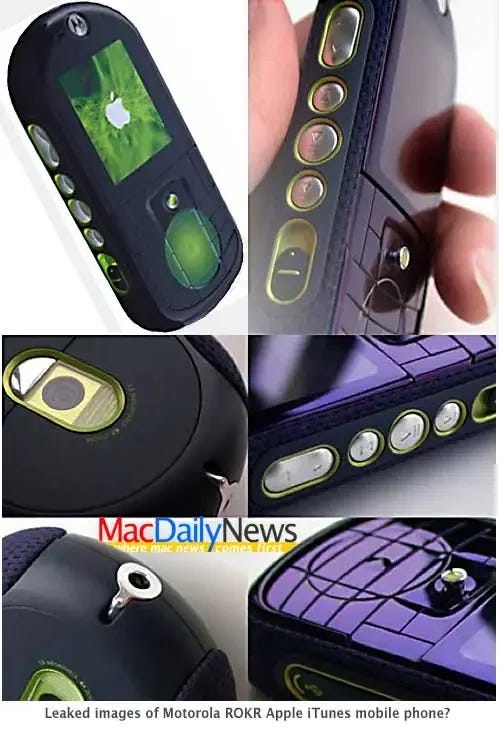
The product, even in rumorville, sounded like garbage. Hilariously, the tech press thought this mock-up by an LSD-addled design undergrad was going to be the real deal.
Meanwhile, Apple was ruling the world. Their products were flying off the shelves, iPods were status symbols, and Macs were popular again. Jobs didn’t need to do this, and he clearly didn’t want to.
So there he was, faced with releasing a phone with a partner that he would consider inferior at best and shitty at worst. But he kept slogging through.
“Today, we are introducing the iTunes phone. This is a phone that we have worked on with Motorola that has an iTunes client in it where you can play iTunes music that you’ve gotten from your CD library or bought from the online store right on your phone,” he said. Listen to his language. “We worked on it with Motorola,” he said. He didn’t build it. Apple didn’t have a hand in the hardware. They put an iTunes client on it. Back in those heady days of Apple, everything was a premium walled garden. You could have an amazing interface, great design, and solid tech, or you could have, well, a Motorola. And he underscored that multiple times.
“The phone is made by Motorola. We have designed the iTunes client and work with them to integrate it into the phone. It’s called a Motorola ROKR. And it’s a pretty cool phone,” he said using language we’d normally reserve for a toddler we don’t know showing us a particularly colorful booger. “It’s a quad-band GSM phone. It’s got a built-in camera, built-in stereo speakers that are quite good actually. Stereo headphones with a headset on them as well.”
I’d go on, but it’s not worth it.
Long before the iPhone put a computer, camera, music player, and phone into one little slab, there was the Motorola ROKR E1. And it was the biggest hunk of crap ever announced at an Apple keynote.
But if it hadn’t been for the ROKR, we’d never have the iPhone.
ROK down to E1 avenue
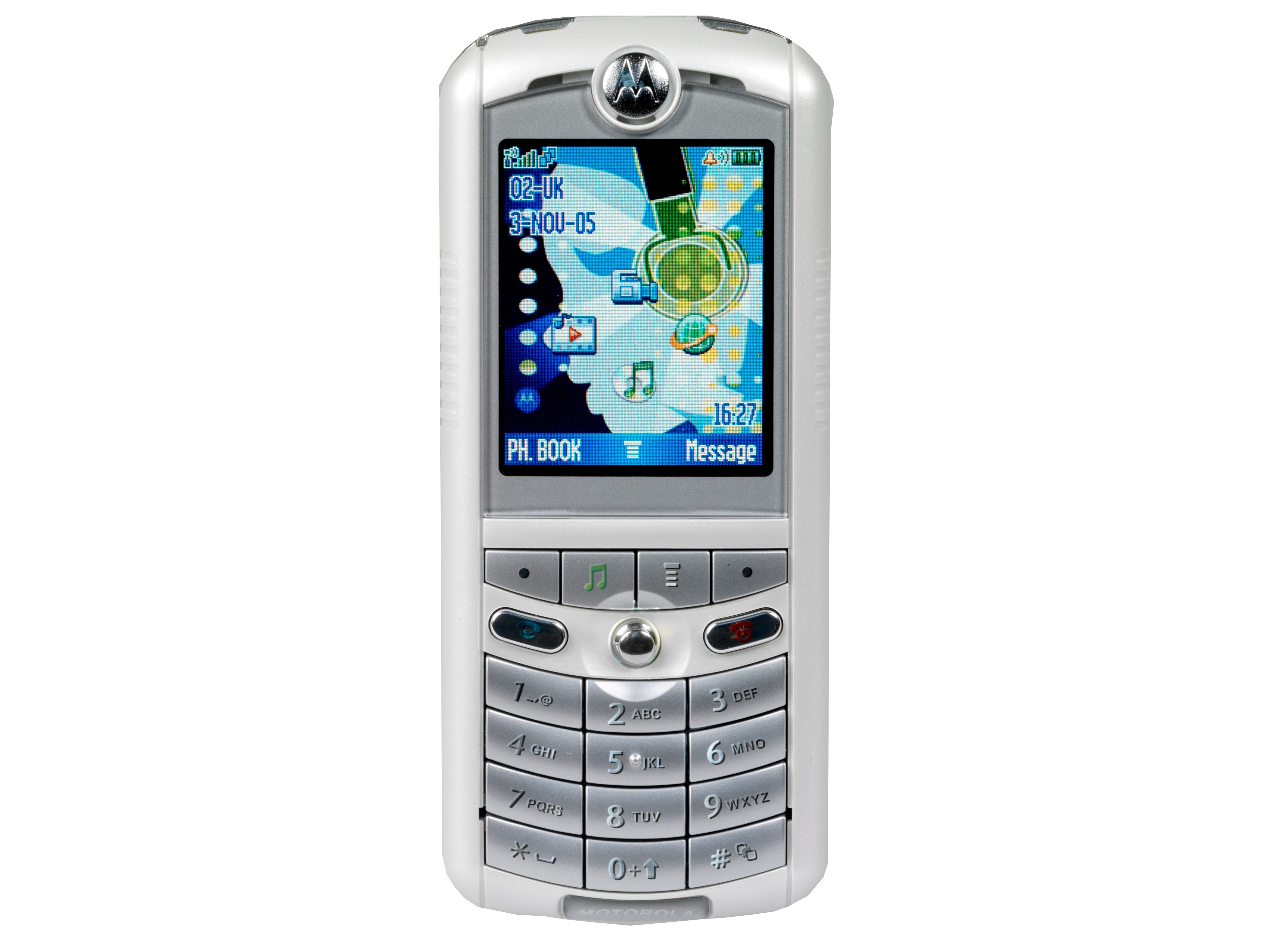
The Motorola ROKR E1 was the first mobile phone to feature official iTunes support, combining Motorola’s E398-based candybar design with Apple’s music software. It was clad in a pearly off-white and orange. It had none of Apple’s design language except for a nod to iTunes in the interface.
The phone featured a 262,000-color display, a dedicated iTunes button, and a joystick for browsing music by song, artist, album, genre, or playlist. It supported MP3, WAV, and AAC files, including DRM-protected tracks purchased through the iTunes Music Store, as well as album artwork, playlists, shuffle playback, podcast bookmarks, and song ratings. Music had to be transferred from a Mac or PC rather than downloaded directly to the phone, with transfers handled over the relatively slow USB 1.1 connection. The ROKR also included side-mounted lights that could flash and vibrate in time with music. And it had “quite good” speakers.
Apple, Motorola, and Cingular pitched it as a way to take your iTunes library out of your computer and put it directly onto your phone. Steve Jobs called it, in effect, an iPod shuffle built into a phone.
It was also kind of terrible.
The ROKR came from a very different period in mobile technology. Phones were becoming cameras, music players, email devices, and tiny web browsers, but nobody had quite figured out how all of those things were supposed to fit together. The ROKR represents one of the strangest attempts.
Consider the interface. The phone had a full set of regular features — a calendar, an address book, and a bit of email and web. It also had that iTunes icon and the iTunes button. Both look like they were slapped on by committee, some lazy exec saying “Make it easy to see but don’t remove the garish Cingular and Motorola logos.”
In other words, iTunes was an afterthought in an era when it “Rip. Mix. Burn.” was the battle cry for turn-of-the-century music lovers. At a time when people were carrying hundreds of songs on their iPods, the ROKR was simply silly.
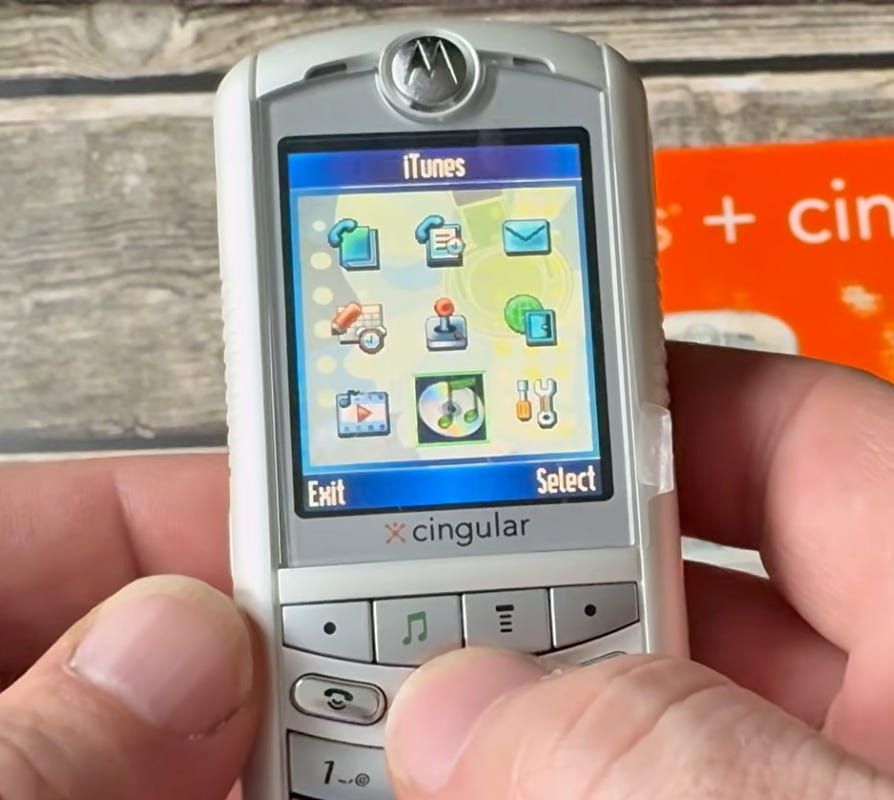
Physically, it wasn’t particularly new. Motorola essentially took the existing E398 candy-bar phone, gave it a white-and-silver finish, and added Apple’s music software. It had a 176 x 220 color screen, a VGA camera, Bluetooth, stereo speakers, and a 512MB TransFlash memory card. It cost $249.99 with a two-year Cingular contract.
Further, the ROKR was one of the first devices to support iTunes loading. Plug the ROKR into your Mac or PC and it showed up in iTunes. You could move purchased music, ripped CDs, podcasts, and audiobooks onto the phone. Album artwork appeared on the tiny screen. When somebody called, your music paused so you could answer.
There was just one ridiculous problem.
You could only carry 100 songs.
Not 100 albums. Not as many songs as would fit on the memory card. Exactly 100 songs.
Even if you installed a larger memory card, the iTunes software wouldn’t play song number 101. The restriction was especially odd because Motorola’s separate music player could play additional MP3 files stored on the card.
Then there was the transfer speed.
The ROKR used a painfully slow USB connection for loading music. Engadget reported that transferring 100 songs took about 42 minutes. There was no iTunes music transfer over Bluetooth and no way to buy songs directly from the phone. You bought or ripped music on your computer, plugged in the ROKR, and waited.
This was particularly strange because Apple introduced the iPod nano at the same event.
The nano was thinner, prettier, and could hold as many as 1,000 songs. So Apple effectively introduced its first iTunes phone and then immediately showed everyone a much better way to carry music.
Reviewers noticed. TechRadar complained about the 100-song limit, slow transfers, and inability to download music over the air. Engadget found the interface sluggish. Stuff later described the ROKR as feeling like an experimental side project rather than a serious Apple product.
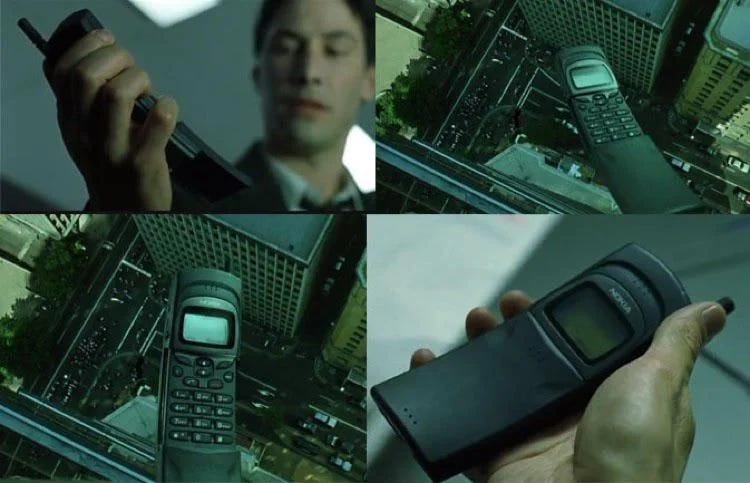
But that’s what makes the ROKR interesting today. The ROKR arrived near the end of an era when phones were still sold largely on hardware design rather than a unified software experience. The constellation of devices produced by Samsung, LG, and Nokia at that time were differentiated not by features but by design. The Nokia 8210 was interesting because it was tiny. The Nokia 8110 had a slide out key cover. The Motorola 120t looked like a bar of soap. There weren’t any special features and each model was approximately the same. Adding iTunes to the ROKR made Motorola stand out, even though they didn’t know how to market the product.
There was also this:
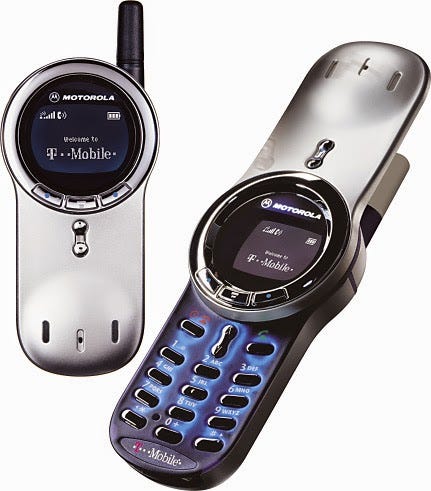
But the ROKRy showed Jobs that people didn’t want to carry a phone and a separate music player forever. Their music library would eventually live on the same device they used for calls, messages, photos, email, and the web. The ROKR tried to make that happen while the old mobile-phone business was still focused on the phone versus the software.
The ROKR was widely regarded as a flop. Apple wanted out.
TechEBlog writes:
Behind the scenes, the ROKR E1 was a learning curve for Apple. Teaming up with Motorola and Cingular was a bumpy ride, exposing the headaches of split design duties. Apple poured its energy into the iTunes software, while Motorola’s hardware gave the phone a clunky, un-Apple vibe. Clashes over song limits, branding, and looks—some called the prototype “ugly”—dogged the project, with Steve Jobs himself labeling it an “experiment,” per Jon Rubinstein, then iPod division chief. This stumble convinced Apple to seize total control, birthing the iPhone, and by September 2006, the ROKR was dropped as Apple chased its own vision.
Less than two years later, Apple introduced the iPhone. The ROKR showed Apple what it didn’t want, and it energized Jobs. Even as smartphones entered the market, he ridiculed them for having styluses and cheap screens. He didn’t like plastic because of the ROKR, so the first iPhone was made of metal. He hated phone interfaces, so he forced his engineers to build skeuomorphic representations of reality that allowed the screens to “rubber band” when you pulled down on lists and date pickers to feel like physical dials. To zoom you pinched with two fingers instead of tapping on an ugly joystick.
Further there was no 100-song limit, no Motorola interface surrounding Apple’s software, and no need to bolt iTunes onto somebody else’s handset.
The ROKR became a technological dead end almost immediately.
But sometimes dead ends are the most interesting gadgets to collect. The ROKR captures a brief moment when Apple knew the phone was going to swallow the iPod, Motorola knew music was going to matter, and neither company quite knew what the resulting device should look like.
The answer wasn’t the ROKR. But for a few months in 2005, this funny little Motorola was the closest thing we had to the future.