
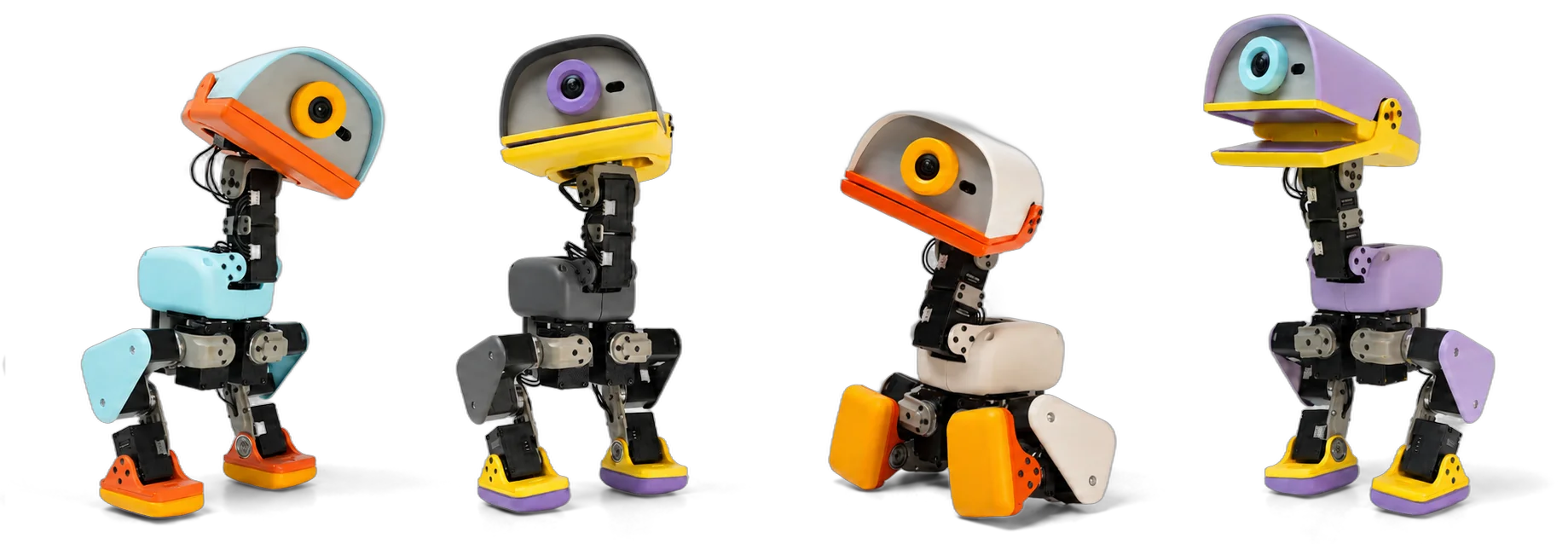
As we enter the era of AI-infused hardware, things are going to get a little weird. As we saw during the Chinese robotic Olympics, we’re getting really good at mimicking the magic of living beings in plastic and silicon, but the cost of humanoid robots is still prohibitive. Enter, then, the Microduck.
This $399 open-source device is basically a little duck with a camera eye, a flappy mouth, and two legs. It can dance, skate, run around, and even sing. What’s more important, however, is the total range of motion and programability.
Like the Chumby, the Microduck is more proof-of-concept than a useful tool. The company, which is part of Huggingface, has been building these kinds of robots since 2016, but presumably the hardware and software have finally come together to allow for something far more interesting to emerge.
Standing just 25 cm tall and weighing 800 grams, the little robot has 15 motors, a camera, LiDAR, and two cameras. It arrives with seven trained movements, including walking, sitting, kicking, grabbing objects, and even getting back onto its feet after falling over. You can even play with the little guy on the Microduck website before you buy.
What makes the Microduck especially interesting is that owners can train their own behaviors in a physics simulator and then run those same policies on the physical robot. Its SDK, simulator, and reinforcement-learning stack are all open source, so this is as much a small robotics development platform as it is a very strange robotic pet. Because you can simulate training in a virtual environment, you can even let the robot teach itself, a feat that was nearly impossible a few years ago.
This thing is silly and expensive, like most cutting-edge hardware should be. It’s a fascinating little toy that hides a lot of smarts inside, and I’d be curious to see what happens when we get more and more devices like this little duck in our homes.


